Maps of the Sahara

April 2008

Most currently available Sahara maps are listed and described below. Only a couple are really useful to desert travellers; others maps may be more easily available and will offer a good background or modern overlay, while some other Sahara maps are of limited value to a desert traveller.

For the average vehicle-based Sahara tour, choose one large-scale Sahara map covering the whole area you plan to visit and then add one- or half-million scale maps for all the areas you plan to cover on pistes. In rare instances these can be backed up by a selection of 200,000s for areas of special interest, or excursions off-piste to places where you expect to have difficulty finding your way through. As a rule, the country maps described below are less useful for travel in the Sahara.

The Sahara maps below are reviewed specifically in regard to their utility as navigational aids for independent desert travellers, not more conventional fly-in tourists. Each of the 70-odd GPS routes detailed in my Sahara guidebook (left) include a recommendation to one of the maps below. Factors I consider useful in a good Sahara map include:

  • Up to date information - certainly in new editions (a common failing)

  • Accurate and consistent hierarchy of roads and pistes (a common failing).

  • Clear depiction of relief (some achieve this better than others)

  • An idea of the surface terrain (very useful but often overlooked)

  • Reliable information on wells (a tall order, but frequently guesses are made)

  • Grid lines across the map face to aid positioning with GPS (it is 2008 after all!)

If you're still in the early planning stages you may find my SAHARA BORDERS ACCESS MAP (right) on the Routes page useful. It shows the major border crossings and where they are best not crossed.


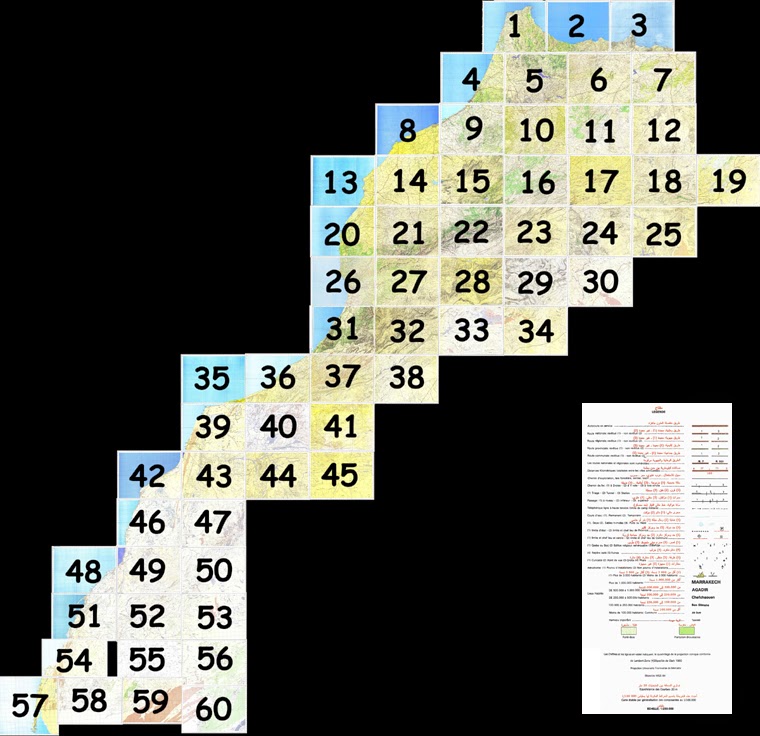
IGN Roamers

Click the above graphics to download a Word (120k) or pdf (588k) file with roamers for IGN maps covering the Sahara. Each roamer (picture) includes a grid covering one square degree of an IGN one million map and is calibrated at either 5 minute or on the Maroc Roamer, 1 minute intervals. Once printed off on acetate (aka, clear film for overhead projectors), it's a less error-prone method of reading a grid reference from a map with a ruler and pencil. Note they are calibrated to read east of the prime meridian (0°E/W) but work on the west side. Roamers are described on p.327 of the book.
Thanks to Terry Davies and Mark Shaw for producing them.


Digital versions of paper maps

The German publisher RK-H who produces waterproof, double-sided country maps of Morocco (1:1m), Algeria 1:1.7m), Tunisia (1:1.6m), Libya (1:1.6m) and Egypt (1:1.25m) (and license some versions to Rough Guides) now offer their maps as digital downloads for €15 euros (the paper maps go for around €9 in Europe or probably as many pounds in the UK).

As long as you have one of these 'PCs' the maps (up to 20mb) are sent pre-calibrated in a choice of major GPS software formats like Ozi or Fugawi. Of course you could buy the paper map and spend an hour or two scanning it yourself bit by bit, joining it up and calibrating it in whatever GPS prog you like (I tried; it's a mess).

Is such a format much use for deep desert navigation? Well in some places, notably Morocco, current maps are (and have to be) a lot more up to date than the IGNs as well as more suitable for ground use than TPCs. The RK-H Morocco map (left) comes at a handy 1:1m scale too. In most cases you won't be able to load it into- or read it from your tiny-screened GPS but you will be able to display it more functionally on a laptop which could be attached to a live-running GPS if you like that sort of thing. I wouldn't be so keen on running a laptop full time in a dusty vehicle bumping along the piste but I could see a scenario where one might be lost and it's a bit quicker/less error prone to open up the map on a laptop and put the cursor on whatever your GPS is reading to see where you are on the map.

Assuming the projection is broadly the same as IGN 1m maps, at the same scale the RK-H Morocco paper map will be useable with the 31ºN & 29 ºN roamer available to download above. It would be a non-digital way of quickly and fairly accurately establishing your position compared to using a ruler and pencil.


Coming soon
5
Detailed review of the best Morocco maps


Map reviews

Michelin 741

Scale 1:4 million, 2007; around £5.
The 741 (formerly '953' and '153' before that) covers nearly all of the Sahara from the Atlantic to western Egypt (28E), making this the first choice for most of the region. Compared to other offerings, this series is renowned for its detail, readability and reasonable accuracy given the huge task involved.

Although it's not perfect the Mich 741 is the best planning map for Saharan travels, giving you a good overview of 90% of the Sahara, accurate relative distances, borders, major roads and some pistes, as well as settlements and surface features, even the depth of some wells and quality of water. Degree intervals in this era of GPS are a not-so-useful 4° apart. This is not a map for off-highway navigation, although many novice Saharans have tried!

The previous edition (2003; the first to be called '741') was nothing more than the 953 it replaced but with an new cover and number. This 2007 edition has a few real changes. It may be just the printing but the contrast and colours are now a little stronger so showing the relief better. But has it got over its age-old flaw: an inaccurate emphasis of some pistes such as thin black lines show long-obsolete camel trails on a par with much more recognised pistes, while other barely-used pistes look like well-used tracks. The quick answer is not really, the black lines where there is not always a piste remain, so Saharan novices will continue to misinterpret this map until they know better. But they have improved the map.

New additions include a string of new or uprated tracks in inland southern Western Sahara (not a place tourists can go easily); the new road to Nouackchott is shown; names have been added to formerly unnamed ergs and mountains in Algeria and tracks are shown to Tamajert as well. Sealed Algerian roads are updated and some (but not all) obsolete 'interdictions' have been lifted too (notably from El Oued via Bir Djedid to the Deb Deb road). But for example the well established 'southern route' between Tam and Djanet via Tin Tarabine and Tiririne (it's been there for 30 years or more) is missing while the route to Bordj Moktar is still shown as interdite even if this is the main way now. Libya gets a few token 'scenic' green stripes and the 'Water Project Hotel' on the way to Waw Namus gets a nice little plug.

These nitpickings apart the new 741 is the first actual improvement since the last 953 of 2000. It remains the definitive map of the Sahara and West Africa, offering a quick way of getting to know this huge region. (In case you can't tell this review concentrates on the Saharan portion of the map).


African Atlases (short version: don't bother)

You may find yourself attracted to the savings of an African atlas, especially if ordering online, sight unseen. A couple that I looked at recently are the National Geographic Africa Adventure Atlas. It's an impressive title but on a continental scale, as expected it is flawed and inconsistent for actual travel use, and when depicting the Sahara sections seems to go all out to save ink (a cunning way of avoiding errors - or the need for accuracy - I suppose). Inevitably, it's heavily focused to the southern and eastern 'safari' regions of Africa where the mapping is more detailed.
Map Studio's Road Atlas of Africa is the same as above, with long out of date infrastructure info on the Sahara. Handy for teachers or for propping up a short table leg, but not for travellers.


Insight Travel Map, North Africa, 1:4m, £5.99 (2003)

The only worthwhile option to a Mich 741, this two-sided map also covers the Egyptian 'Mich 742' sheet with a healthy overlap and features the legend in eight European languages, as well as coming with a fat atlaseresque index booklet. Nice. It also features a two degree grid interval (Mich uses 4°). As always, they slip up on correctly depicting the hierarchy of the highways and pistes - in other words the difference between a sealed and regular road and a rough piste; things that you'd want to know, especially if it's raining or you're not in an ATV.
So for example in Mali, the road running from Gao southwest to Mopti (sealed in the mid-1980s) is depicted as the same as the sometimes rough Tanezrouft piste. In Niger we find 'Achegour portable' on the Dirkou-Adadez truck piste - a movable village perhaps? or misunderstanding the meaning of 'potable' (drinkable water) clearly pinched from the Mich 741? This major piste is marked the same as the tough Zoo Baba dune route to Nguigmi, while the camel and tourist piste via Fachi through the dunes gets prominence - true 40 years ago perhaps. Algeria is better depicted than the RK-H (see below) but the piste from Tam across the Sahara is again the same level as the sealed Mopti road, while south of In Amenas to Djanet (a highway for years) is a grade below. Libya also has poor or outdated road info and the Gilf in Egypt is barely featured (we can forgive them for that - what is 'the Gilf' anyway?).
However, a quick glance at the latest 741 (above) instantly shows the Mich's superiority, with broadly accurate and bold coloration for sand seas and mountain/plateau relief, giving a vivid but not lurid impression of the desert surface, even if the road hierarchy is also inconsistent.


Institute Geographique Nationale (IGN)

Scales 1 million;1:500,000;1:200,000.
Dates Early 1960s to mid-1970s.
Price 1 million £7.95 in the UK; 10 euros in Paris. 1:500,000 and 1:200,000 sheets in Paris from 8-13 euros (see below) or on bootleg CD (Niger, Algeria and Mauritania only).
The one million IGNs are to general purpose desert navigation what the 741 is to planning. The are great maps but only cover the former French African colonies which only includes the western reaches of Libya (up to 12E). Readability from 1964 up to the last sheets in 1975 is very good. A few 1961 sheets covering ever-overlooked Mauritania are a little basic by comparison.
The advent of GPS has brought up a few errors with the one millions - mountains misplaced by a few kilometres - but overall the detail and accuracy is excellent as subsequent satellite imagery has proved. Changes in roads are best cross referenced on a 741 or a modern country map (see below) and don't expect all the marked wells to have been maintained over the last few decades while new ones will have appeared. Particularly in the more populous Sahel, the position of tracks and other man-made features may have altered over the last few decades. Excepting parts of Libya and all of Egypt, these excellent maps are ideal for the basic level of exploration and travel that Sahara Overland represents.


Coverage of 500k IGNs seems to have been patchy and these days they are very hard to find and not really worth the bother. For some odd reason detail is cut off at country boundaries, even adjacent former French ones, which makes them a little less worth searching out though of course the extra detail makes perhaps the best scale of all for piste driving. Half millions are not available at the Espace IGN Cartothèque in Paris but they are available on bootleg CDs (Algeria only, as far as I know.)
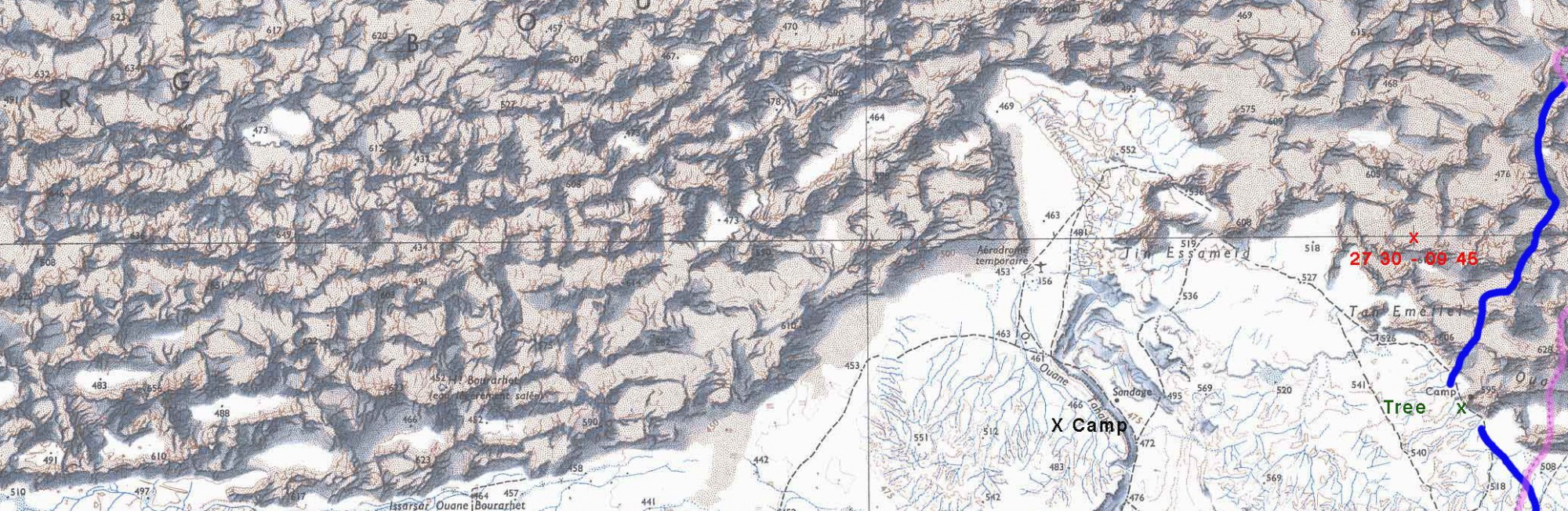
Just about all the original 200,000s have been sold or returned to the relevant countries with only the odd sheet turning up in the book shops of Paris or Geneva. Theoretically still available from the relevant ministries in Algeria, Niger and Mali, their 'strategic' scale makes obtaining them a hit-and-miss affair. Nevertheless, when you can find them, the colour originals are real works of map art, especially in mixed dune and rock terrain - they are the finest maps of the Sahara ever made, rivalling the more recent Russian equivalents which are only based on aerial or satellite photography. IGN's were checked on the ground too, and it shows. Black-and-white copies of the full set are available from the IGN Cartothèque in Paris at around 7 euro each and are also widely sold on CD by the major Saharan outfitters in Europe, some avoiding the copyright issue by not crediting the maps as IGNs. They seem to no longer be available in the UK.
The biggest drawback with the 200,000s is that there are no or limited grid lines on the face of the map and each degree is only marked in 10-minute increments along the borders. If you look closely there are actually faint crosses also at ten minute intervals on the map face, so it's possible to mark your own grid - but draw from cross to cross and not straight across, even though, given their UTM projection, lines are almost straight.

IGN country maps

IGN also produces a modern 'Pays et villes du monde' series of country maps which in the Sahara includes Chad, Egypt, Mali, Morocco, Mauritania, Niger and Tunisia. Produced or updated in the last decade they have scales ranging from one- to 2.5 million and are easily available in Europe and selectively from the UK map specialists for £9 (as many euros or less in Europe). With grid lines at one-degree intervals, the 1996 1:1m 'Maroc' sheet is superior but out of date on new sealed roads compared to the latest Michelin 742. The usefulness of other IGN country maps fits somewhere between an up-to-date Michelin 741 and an IGN one million. 'Chad' has no grid lines for example. Libya, now a popular destination, is notably missing and will never be produced because it was not once a former French colony and so it's existence is marginal au mieux!
I spotted the the hard-to-find-in-Europe half-mil IGN map of the Air Massif (pictured right) at Agadez airport recently for 12 euros - especially handy for camelling or trekking in the region.


Reise Know-How Series

Scale Around 1:1.7 million
Date Latest 2007
Price About £9 or €9
Availability Easy to get hold of in the EU

Leading the trend with double-sided Copyart plastic water- and tear proof 'paper', what a shame that RKH missed the chance to make a definitive sheet on Algeria and Tunisia. The colouration and detail is too subtle by far (another ink-saving ploy?). Some well-established pistes are missing, the Tefedest range seems to have a new pass halfway up, but the worse thing in the overpowering anaemia of this map - all the same pale washed-out tan tone with no discernible definition for the dominant ergs and a way too-large contour interval of 250m for the 1.7m scale - a map clearly that did not eat enough fruit and veg during its production. You do get a handy 1° grid (but not sub-calibration, like a TPC or IGN 1m). With the wealth of Algeria know-how in Germany, this map is a missed opportunity.
Both new for 2007 are a Libya at 1:1.6m and a Morocco at 1:1m - to be reviewed shortly.


International Travel Map Series

Scale Around 1:2 million
Date Produced in recent years
Price About £10 or $10
Availability Widely available in North America (eg: amazon), overpriced in UK and Europe

As well as the attempt at covering the Sahara (see above) ITMB of Canada have produced several country sheets of Mauritania (1:2m), Niger (1:2m), Mali (1:2.4m), and Libya (1:2.6m, in tear- and waterproof plastic with3° grid interval, 2006; £9.95 at Stanfords, London). None of these are really serious attempt to cover the Sahara for the traveller (when compared to the recycled IGN 'country' series). Places names seem to have been transcribed down a bad phone line from Tripoli and include some ludicrous errors that could not be solely laid of the poor state of international telecoms. The Mauritania map still shows piste from Dakhla to Nouakchott.
In Niger we learn of a dinosaur cemetery round the back of Bilma (news to me; could they mean Gadoufaoua SE of Agadez?). There is a pictograph near Aney (maybe) and another in Blaka (true), but none of the rich engravings sites along the east edge of the Aïr are identified. And you have to say, what is depicted of Algeria around Tam and the Hoggar (and around Djanet on the Libya map) is all mixed up, piste wise, that bears more relation to overzealous cartography than any existing map.
The new Libya map has poor depiction of relief, pistes are very faintly marked (in case they're wrong?) and in the Ubari lake region we read of 'numerous waterholes' but not one of the lakes, and on many ITM Sahara maps a dead give away is the use of 'limit of reliable relief information', showing they've been scanning American TPCs (see below) but don't comprehend that TPCs are actually pilots' charts; relief info is less useful to earthbound mortals than wells or pistes.
With glaring errors and inventions rather than the more common inconsistencies and inaccuracies, it would be hard to have confidence in travelling with these maps in thr Sahara and many of the potentially useful town plans are skimpy in the extreme.
ITM have also produced a Sahara map; a rival to Michelin's 741? It would be nice to have a good alternative and the 1:2.2m scale is promising, but a quick scan shows up more errors and omissions as well as an inferior design to the Mich. Stick with a 741 of the Insight North Africa.


A couple of Libya and Algeria maps for you: the Malt 'fantasy' map of Libya (1:3.5m) is still around and good for nothing, while even with a rugged 30-year-old Range Rover on the front cover, Cartographia's 1:2m effort only goes down to 26°N (above Ghat and Kufra) - about as useful as the famed chocolate piston then. Gizi's Algeria sheet (1.2.5m, £8.95) has a 1° grid and is not bad at all. Usefully it has place names in Arabic but the paper is rather old-fashioned thick and glossy (like the Malt) which you feel won't last, and I found the colouration of the relief a bit over the top (the terrain, dunes, reg, was not well depicted). Gizi also do a Libya map at 1:1.75 (to be reviewed)


Soviet World Series

Scales 1 million;1:500,000; 1:200,000
Date
From the early 1970s to mid-1980s
Price Varies greatly - most buy one of the three Africa regional CDs, bootleg or otherwise
Availability
Saharan specialists in Germany, Switzerland and France. Also available on CD (see below).
The Soviet Union produced a range of topographic maps covering the world at the above scales, making them the only ones to cover Libya, where they match IGN's earlier efforts to the west but at a lower quality. Difficulties include the Cyrillic (Russian) text and what appears to be less than full-colour printing. Their worst feature is representing dunes as a series of still more orange contours rather than with colour and shade as with IGNs. Some are sold as black-and-white copies which makes them hard to read.
Nevertheless, they're the best there is for Libya, with the half million originals noticeably easier to read than the one millions even if availability of originals seems patchy. In most cases the large scale 200,000s have to be ordered, even from clued-up European outlets.

With reduced copyright restrictions, enterprising individuals and organisations like Quo Vadis are scanning the entire Russian series and selling them on CD. All of Africa at 1:500,000 would cost over £1500 in paper but can be bought direct from Quo Vadis for around 100 euros which would include the two dozen sheets which cover the Libyan Sahara - still a saving of 30 percent. This may sound a bargain but would still require printing off several sheets of paper and joining them together to make one complete sheet. Then again, the fact that the useful 1:500,000 scale is not properly available from IGN makes the Quo Vadis CDs valuable for the entire Sahara and not just Libya.
When buying these maps on paper, always go for the semi-colour originals if you can and expect to spend an evening familiarising yourself with place names and the Russian alphabet and writing the translations onto the maps, where necessary (see p.331 of the book). The Quo Vadis CD maps feature overprinted names of major towns in Roman alphabet and incorporate GPS plotting software for PCs - another story...


US Defence Mapping Agency

Scale Operational Navigation Charts (ONC) 1:1 million. Tactical Pilotage Charts (TPC) 1:500,000
Date Produced in the 1960s and 70s, revised in the late 1980s
Price From £6 in the UK
Availability Widely available from map specialists worldwide
Description While they are of a seemingly useful scale, widely sold as 'Sahara maps' and open out to the size of a bed sheet, ONCs and TPCs are pilots' maps and much over-rated for terrestrial use. Differentiation of relief and surface is poor and, in the Sahara at least, no attempt is make to distinguish between a mule track or a six lane motorway with regular rest areas. Settlements, where they appear, are rated chiefly by their airport and radio facilities. Terrain differentiation is not so clearly depicted and well information is particularly hit-and-miss: some wells I've drunk from are missing while others which are marked may no longer exist.
One sheet I have grown fond of over the years is the TPC H-3D (too many tracks, but), and the ONC H3 in west Libya was surprisingly accurate on tracks. They're all best used as back-ups to other maps, ideally IGNs.


ONCs and TPCs maps also show the UTM grid overprinted in blue, as well as lines of magnetic variation which are also irrelevant with a GPS's built-in true-north pointing compass. Being flyers' maps, they're pretty hot on maximum elevations in given grid squares - little use on the ground.
However, as with the Russian maps, an evening's close scrutiny sorting out which track might be yours will be profitable. In some instances the ONC or TPC will give an absolutely accurate orientation of a track (Route L1 being a case in point), but most of the time they're confusing and need to be made sense of with another definitive map.
Good things about ONCs and TPCs is that each grid line across the map has an incremental scale of one minute making accurate position-marking easy. The size can be awkward, but the half-million TPCs, make useful 'master maps' to mark up and plot your own routes over a large area. They're certainly not much use for actual desert navigation compared to the Russian and French alternatives.


British MoD

Scale 1:2 million
Date Late 1960s
Availability Hard to find in the UK and rare in Europe
Description These maps combine out-of-date information with an insufficiently large scale to be useful for desert navigation. While a bit of a red herring as they're hard to find. At 1:2 million they cover the same area as an ONC but at half the size and without the aeronautical claptrap. They're not really much use on the piste, with detail in 'non-British' regions much patchier than Sheet 9, 'Dakhla Oasis' (the Libyan Desert). Here the intimate British knowledge of the region dating back to the Bagnold era is evident with heart-warming detail totally absent further west: 'Soft ground', 'Dunes difficult to cross', 'Soft clays, Wellingtons advisable'. It even describes the Darb el Arbain caravan route coming up for Sudan (the 'Forty Days Road') as 'Camel route 1 mile wide marked with camel bones'. Now you know.
In the same series I've come across one million MoD maps from the fifties (pretty rare) which, as far as readability goes, show what a good job IGN did at the same scale without needing eyes like an owl. For Sahara map collectors only.


Moroccan Ministère de l'Agriculture

Scale 1:250,000
Date Early 1990s?
Price Around 8 euros
Availability Mono copies from Ulysse in Paris and maybe others.
Description This relatively recent coverage of Morocco is clear to read even in mono copy (I haven't seen a colour original, assuming they exist) and has grid lines at half-degree intervals which makes them better than 200,000 IGNs. Oddly though, the only sheet I've used lacked much geographical detail. Wells, new small towns and forts that we passed were not marked although the track was correctly oriented - as if the maps were actually much older than the date shown.
Not that it matters as there is little practical use for such large-scale maps in Morocco unless you're planning some off-piste connections. The one million IGN country map is certainly adequate for all the Moroccan routes in this book.


Survey of Egypt

Scale 1:500,000
Date Mid-1930s to mid-1970s
Price LE15 per sheet; £2.40 per badly printed colour sheet
Availability Egyptian Survey Authority 1, Abdel Salam Aref Square, Orman, Giza. (all original good quality Uweinats sold out)
These maps were originally drawn for the Survey of Egypt in the 1930s by Clayton, with a few details added by Bagnold and Almasy, and are still in print. The relevant sheets for the Western and Libyan Deserts are 'Siwa', 'Farafra', 'Dakhla' ,'Uweinat' (see below), 'Qena' and 'Aswan'.
The now unavailable Uweinat sheet dates from 1942 is very good, with neat contour colours and quite accurate. The Dakhla sheet has inferior printing and the newer editions get progressively worse. In this region you're better off with Russian maps (see above) and maybe a TPC H4-C for back-up and marking.


Uweinat 1942 (124mb) - £10/15 euro

Origin: Survey of Egypt
Date: 1942
Scale: 1:500k
Size: 101 x 72cm
Colouration: Full colour
Area: Southwest Egypt with some overlap into Libya and Sudan
LONG/LAT approx: 21° 45' to 24° 15N, 24° 40' to 29°E
Description: An excellent, accurate and detailed map of the southern Gilf Kebir and Jebel Uweinat, still prized today for navigational purposes but no longer available on paper (at a print quality worth owning).

To order this map on CD email me (you'll need to put an @ in the email). Crediting my PayPal account in any currency is best. Please email me for my PayPal account ID before you pay - it is not the email above.

Some Map Sources

Stanfords

12-14 Long Acre, London WC2. tel 0207 836 1321; fax 0207 836 0189
Stanfords' reputation for worldwide stock of maps has slipped from its heyday. For the Sahara it only keeps a patchy selection of one million IGNs and a heap of ONCs/TPCs. As with many of their exotic maps, they're up to twice the price of European outlets, but they do sell Desert Travels!

The Map Shop

Upton on Severn, Glos
tel: 0800 085 40 80 (UK only)
IGN one mils for £7.95 and TPCs for £6 - with a prompt postal service.

Paris
(Haven't visited these places below for years - could be out of date)

Librairie Ulysse

26 rue Saint Louis en L'Ile, 75004.
Small shop piled to the rafters and three deep with used and new books including plenty on the Sahara. Dominique was the in-house map expert last time I was there, speaks English and knows the Sahara map scene. I have found their mono copies of Russian maps better than Därrs', being on thinner, harder paper.

IGN Map Shop

107 rue la Boétie, 75008. tel + 33 / 01 42 56 06 68.
(Mon-Sat. 9.30am-7pm. Metro: St Philippe du Roule).
IGN's city-centre outlet with a full stock of one millions and country maps as well as a couple of Sahara guidebooks.IGN one millions are about €10 here.

Espace IGN
2 avenue Pasteur, 75018. tel + 33/01 43 98 80 00.
(Mon-Fri 8.30am-4.30pm. Metro: St-Mandé Tourelle).
Deals with mail order or head for the Cartothèque department for 200,000 counter sales. A small reference library of guidebooks.

Därrs Travel Shop

Theresienstrasse 66, D-80333 Munich. tel + 49/ (0) 89 282032; fax: + 49/ (0) 89 28 25 25
(Mon-Fri 10am-5pm, Sat 10am-2pm). IGNs including 200,000s, Russian maps of Libya or mono copies in all scales (see Ulysse, above; 200,000s to order), ONCs and TPCs and Quo Vadis Russian maps on CD. Now also offering IGN 1:500,000 and 1:200,000 of Algeria on CDs ready to use with Quo Vadis and Fugawa software.


Niger and Mali (for non-CD bootleg, sub-million scale paper IGNs)

IGN du Niger
Avenue de Ministères, BP 250, Niamey, Niger. 72.33.23.
Source of original colour IGN 200,000 maps.

IGN du Mali
Directorate Nationale de la Cartographie et la Topographie.
BP 240, Bamako, Mali. IGN 200,000 maps of Mali.


© Chris Scott, 1998-2008. Important Notice: These websites operate on Fijian Standard Time (FST)