MAURITANIA
February 2013
Get visas in Rabat or your home country.
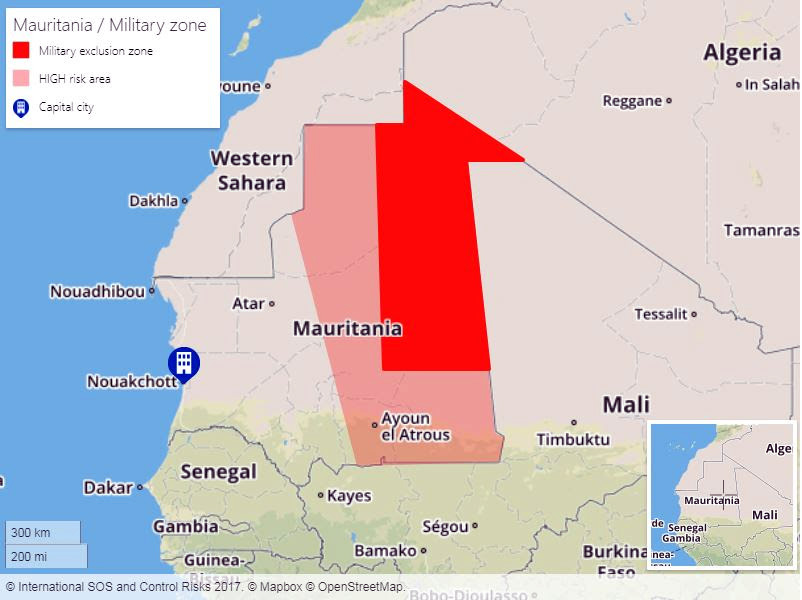
Avoid the border regions with Mali in the southeast.
The Nouadhibou-Nouakchott highway is secure with several checkpoints and roadhouses
Mauritanian ouguiya exchange rates
Price of
fuel
About 380oogs a litre of dieselin Nouakchott - more in the countryside.
Costs
Moderate
Useful languages
French,
Arabic
Visas:
Visas are not isued at the Morocco-Mori
border. Apply in Rabat:
6, Rue Thami Lamdawar
Rabat-Souissi
N33°58.8', W06°49.9'
email (+212) (537) 65 66 78
Apply Monday
to Thursday 8-11am (queueing from 6am, some sleep in their cars), and collect next afternoon or later - the system seems to have faltered a bit. Read this. A 30-day visa costs 340dh and is now valid from a date you specify on your application, not the date of issue. A 90-day (possibly double entry) visa costs 680DH.
For either you need 2 photos, a copy of your passport,
and 2 copies of the visa forms they hand out. For photos and copies there is a supermarket at the cross roads about 100 metres away (N33° 58.93' W06° 49.75; opens at 7.30am).
The Mali embassy is in the same street, 100m away.
7, Rue Thami Lamdawar
Rabat-Souissi
GPS N33 58.8' W06 50.0'
There is also a Mali embassy in Nouakchott - visas issued in as little as an hour on a good day.
From Mali northwards into Mauritania
At Nioro they are no longer issuing visas at the border... you can get a visa at Bamako near the Chinese Embassy on Rue Kolikoro. You need 4 photos; ready next day for 20,000 CFA.
Border formalities
from Morocco
Having come across the 5kms of
rubble road from where the tarmac ends out
of Morocco (N21° 21.8' W16° 57.6'), you get to the newly-opened buildings at the start of the Mauritanian tarmac (N21° 20.0' W16° 56.8') where you get stamped
by the Gendarmerie (free but a present is often requested). You then buy
a visa if necessary (see above)
or have your pre-obtained visa stamped
in at the Police.
Next, get a
white A4 30-day
temporary vehicle import form (Engagement
sur honneur
- 10 euros).
Then optionally buy
official currency if you didn't buy black in No Man's Land.
You can then buy insurance. It took us a while to get all
the paperwork and windscreen stickers and cost us 4300 oogs for 10 days.
If you want you can also get a forward-dated 'Carte Brun' here for the ECOWAS West African countries (not Mauritania). This is regional motor insurance, similar to the regional laisser passer 'local carnet'.
Note that they now search your vehicle a little more thoroughly and may not take too well to cheaper Moroccan petrol in jerricans or alcohol.
Nothing doing
exit or entry wise with Bir
Mogrein exit to northern Western Sahara or Algeria (long time closed).
In
2007 a guy was killed and another badly
injured but a landmine while needlessly straying east just a couple of kms from
the unsealed track through No Man's Land. Full story and maps for
clarification here. Locals (possible evading the border) were also killed in this way in 2009.
There are now over a dozen checkpoints on the road from NDB to NKT. As in the Western Sahara, handing out a pre-printed form with your details saves time. You can download a Word template by clicking this. Make at least two dozen.
The Route d'Espoir east to Nema from Nouakchott is also patrolled but less safe. In November 2012 a single traveller was probably spotted in this area and then kidnapped soon after he crossed into Mali near Diama. More news and advice here. Avoid crossings into Mali east of Nioro - AQIM may operate there.
Desert pistes
Now that the road
is sealed, a lot of people shoot through
Mori and don't give it a chance. Others recognise
that these days it's the only real Saharan
country left where you can still drive anywhere
they will allow without a mandatory guide, although lately they try and insist you get to a town before dark and camp by a police station.
The run along the railway to Choum is a good
introduction to the desert with easy
navigation and some extended dune bands; it gets soft and tussocky
so for these sections motorbikes may find
it easier on the coarse gravel between the
rail tracks; no sleepers (see link
to updated account at the bottom). The Adrar
plateau between Atar, Ouadane and Tidjikja
offers some great opportunities. Tracks
are rare on the long piste following the
Dhar Tichit escarpment between Tidjikja
and Nema and Nema may not be a good place to go these days. Full details of these tracks and
more in the
book.
North
of the Adrar is little explored, but possibly not actually out of bounds on the northwest corner west of 10°W (see this). You won't make it to Chegga
fort where Mali and Algeria meet. In late
2006 we drove direct from Ouadane east to
Bordj Moktar in Algeria and beyond - a
technically easy if very remote 2000km
off-piste traverse that was not without
risks in northern Mali. Trip report from far north Mori in late 2011 here - stick to the Zouerat road and you should be OK, but of course it's a dead end.
The Route R2 update from the border via Choum to Atar (520km, p.468 in
the book) is available to download here. Since 2011 it's said to be much improved – maybe for sealing one day – although the sandy stretches are still sandy.

And now there's a Google map with added information here.