A short photo and video commentary
of this trip appears on my
new Desert Driving dvd
To
most people one part of the Sahara must be very
much like any other, but some corners are more ‘Sahara’ than
others. One such place is the Libyan Desert,
the eastern third of the Sahara, covering not
only Libya, but western Egypt and northern Sudan
too.
What sets the Libyan Desert apart is that it is ten times more arid than the rest of the Sahara: the Libyan Desert is the über Sahara.
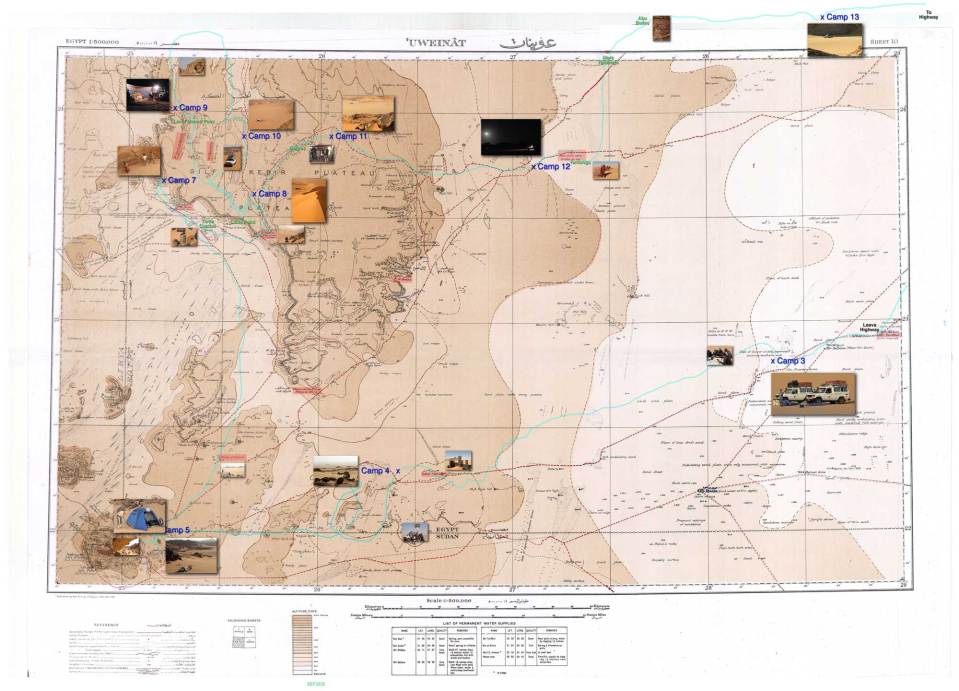
In an area the size of the UK through which we’d
be travelling there is just one usable well and
that single well outnumbers the permanent population.
Looking out my window I can see more trees than
we saw in two weeks and 2500km of travel. Even
by Saharan standards, the Libyan Desert is extreme.
Abbreviated
to ‘the Gilf’, the Egyptian part
of the Libyan Desert is a mini Sahara in itself,
encapsulating all the archetypal desert landforms.
The Great Sand Sea lived up to its name, a dune
field 200 kilometres wide and 600 long with dunes
200-feet high. It was here where the earliest
experiments in driving cars on sand were made
in the 1920s by the likes of Clayton and Bagnold
(left). Its southern edge spilled over the massive
Gilf Kebir plateau only discovered by Egyptian
explorer Kemal el Din in 1922 using Citroen half-tracks.
South of the Gilf a sand sheet led to the isolated
mountain of Jebel Uweinat which sits right across
the borders of Egypt, Sudan and Libya. Our expedition
was to last a fortnight and cover some 2500 kilometres.
The plan was to pass down the east side of the
Sand Sea to the Gilf, explore its eastern valleys
and push on south to Uweinat mountain which we
hoped to climb. From there we’d
head back up to the southern cliffs of the Gilf,
visiting the real Cave of the Swimmers made famous
in the English Patient movie, and then skirt
up the western edge of the plateau and plough through
the heart of the Sand Sea for a couple of days
to the oasis of Siwa, famed since the visit of
Alexander the Great.
Our crack team of Saharaholics
included photographer Toby Savage who co-presents
my Desert
Driving dvd,
Dr Kevin White who’d worked with Toby on
the Fezzan Project in Libya over several seasons
searching for prehistoric lake beds, and Oxford
climatologist Richard Washington whose bedtime
reading included AppliedPrinciples of Arid
Zone Aeoleonics,
or ‘dust storms’ to you and me.
We’d all travelled in the Sahara with our own four-wheelers, but shipping them to Egypt was never an option: too far, too expensive and, for the three weeks we’d given ourselves, bureaucratically maddening. Better by far to get Toby’s
Egyptian mate Mahmoud to lay on three vehicles
for the 2500km trip. Mahmoud already had plenty
of experience exploring the area himself in his
old Series III. For all of us used to looking
after ourselves on our own desert trips, being
pampered in this way was a bit luxury. Normally
navigation, the vehicle, cooking and everything
else would be down to us; on this trip we could
sit back, enjoy the desert scenery and let someone
else carry the load for a change.
A week before Christmas,
Mahmoud met us at Cairo airport in a suped-up
minibus and whisked us off for lunch on the Nile
before we set off for the 400-km slog south to
Bahariya oasis where the vehicles awaited us.
On the way we speculated as to what those machines
might be because, as I knew myself from a recce
tour three years earlier, the ‘Gilf’ was
tough on cars. Six hundred litres of fuel – 130
gallons per vehicle – was a typical
payload, let alone food and water for a fortnight.
We’d
expect to see no one during out travels, with
only the wadis around Jebel Uweinat offering
the chance to replenish the single resource: firewood.
Driving desert highways at night
is always a spooky experience. Small dunes shone
in the moonlight and up ahead a cluster of lights
signalled a lonely roadhouse, surrounded by trucks
and vans serving the towns of the Western Oases.
We pulled over for a brew to find everyone on both
sides of the counter huddled around a dusty TV
screen, On it a hirsute and spaced-out Sadaam Hussein
was getting his gums probed by Special Forces,
having just been dragged out of his lair.
Next
morning in Bahariya we met up with Mahmoud’s pumpkin-bellied mate Loutfi who ran a local hotel and tourist excursions into the desert and nearby hot springs. Mahmoud and the vehicles were down the road a way: he had left before dawn for Dakhla to pick up the military escort which every tour in the Gilf requires. So we bundled into Loutfi’s
60-series Land Cruiser for the drive south to
Abu Mungar and a rendezvous with Mahmoud in the
desert.
All around us lay barren desert
sands rimmed by the arching 600km escarpment that
defines the Western Oases of Bahariya, Farafra
Dakhla and Kharga.
In
Pharaonic times what lay beyond was known
as the Land of the Dead and even today,
5000 years later, the wilderness of dunes,
sand sheet and rocky plateaux is still
unpopulated...
In Pharaonic times what lay
beyond was known as the Land of the Dead and even
today, 5000 years later, the wilderness of dunes,
sand sheet and rocky plateaux is still unpopulated,
with just half a dozen towns of any size lay between
ourselves and the Atlantic, 2000 miles to the west.
Loutfi’s
60 had just had a engine transplant, a grunty
12HT 4-litre turbo diesel, but by lunchtime it
was getting distinctly hot. The needle was sitting
in the red, there were burning rubber smells
coming through the vents and the turbo was making
an audible whine. Maybe this wasn’t the machine
we’d
be wanting in the Gilf after all. Our
quartet of backseat drivers watched the needle
and muttered, waiting for the turbo or head gasket
to blow. Loutfi pulled over to let the machine
cool down and, once satisfied the needle had backed
off, headed on south. Again the Tojo was cooking
itself but Loutfi then confounded us by pulling
off the road into the desert. None of us knew quite
what was going on but heading solo off-road with
overheating problems seemed unorthodox. We churned
over a few sandy passes, stopped off at the famous
White Desert chalk outcrops and then bundled on
to who knows where.
Presently we got
back to the highway where Loutfi seemed unsure
whether to turn left or right. He drove down
the road a bit, looking out west, then turned
back north. He spoke no English so we had no idea
what was going on; had he lost something? Then
he turned round once more, looking hard out to
the west. He slammed on the brakes and did a U-ey.
Ah ha, there it was: a hooned-out sand circle,
a small cairn and three sets of tracks leading
out into the void. Following these, within a few
clicks we came upon a desert camp, the cars locked
in the customary Gilf 'U' formation against the
northerly wind. Mahmoud was there to greet us with
smiley Ibrahim in his Bedouin head dress, our ‘guard’ Hamed
in a snazzy maroon shellsuit, Faraq the mechanic
and Aisa, a cool dude in a pair of knackered cowboy
boots and matching hat who was to be our cook for
the next fortnight.
The identity of
our three desert machines was revealed: Mahmoud’s
Series III-bodied Toyota, a 110 Land Rover, which
also had a 3.5 litre Tojo bus engine and gearbox,
and Loutfi’s other car, a red HJ45, the
old squared-off Land Cruisers from the late Seventies,
but also with a newer six-cylinder 12HT turbo
engine crammed under the lid. With potentially
the best engine, the 45 was the load carrier;
inside it, three 200-litre drums of diesel were
lashed down with rope while on the roofs of all
cars were additional jerries of fuel which, with
the full tanks, added up to 2000 litres, more
than enough for as many kilometres over the next
fortnight. But with no car running an original
engine or less than two decades old, we could
see that spannerman Faraq wasn’t
going to have a holiday.
That evening, in
the cozy shelter of the U-camp, Richard and I
keyed in our sat phones with Mahmoud’s so we’d have some sort of comms if we got separated and things turned pear-shaped. Mahmoud outlined tomorrow’s
route: we were in the very edge of a series of
parallel dunes running north-south; crossing
the dunes would be impossible with the cars in
their current overloaded state, but we could
hopefully run down the 500m-wide corridors between
the dunes as far as possible and ease over any
low passes to gain ground to the west.
Next morning, knowing that things
would get off to a slow start, Toby, Wash and I
set off for a wander into the dunes to let the
cars catch us up. After an hour there was still
so sign of them, so we sat down on a high dune
and scanned to the east, ears primed. Finally about
10am they turned up, having had problems getting
one of the engines to fire up. We all hopped in
and set off down the nearest corridor to see how
far we could get. I was in the white 110 which
inside looked like it had been a prop in The Birds,
with every surface pecked to bits and wires hanging
off the dash like splashed spaghetti. Still,
the engine sounded good and it carried its weight
well.
It didn’t take long before
one of the vehicles struck trouble: the 45 had
brake problems, but whatever it was Faraq fixed
it in a jiffy and we moved on until the next:
Mahmoud’s ‘Lanyota’ could
not shift into low range. Faraq crawled in and
tightened up the linkage with a bit of wire. The
rack was also sinking in the gutters which on Defenders
and the like means you can’t open the doors.
(You couldn’t
anyway as the door handles were buggered.) And
the air bags which were backing up the rear parabolics
were squeezing out like bars of wet soap.
These were fixed
as best they could be and we moved on. Even in
dune corridors the sand can change imperceptibly;
one minute you’re clawing along at a decent
pace, next thing the car sinks like a stone – but
if you’re fast with the shifting and accelerator
you’ll get through it. Momentum is the
key to dune driving; once you’ve
lost it you may as well pull up and put the kettle
on. All of the vehicles got mired in soft patches
several times and we all got stuck into pushing
the cars back out, the quickest way of getting
going if the driver has stopped early enough.
... creating gaps in
the gear ratios big enough to frighten Evel
Kineval.
Part of the problem
was that the Totoya gearboxes in the
two Land Rovers were not optimised to the Land
Rover axles, creating gaps in the gear ratios
big enough to frighten Evel Kineval. Mahmoud’s
Land Rover had an even more alarming habit of
getting on two wheels while cornering hard, something
which Mahmoud tended to do with gusto; I sure
was glad I wasn’t
in his car. By comparison, Ibrahim in the white
110 was a steady and smooth driver, never taking
risks while struggling with the same mixed-up
gearing and, it turned out later, no power steering.
By
late afternoon we needed to get west, but high
dunes were blocking the way. Mahmoud was nosing
about for a way through but the heavy vehicles
were struggling in the corridors, let alone trying
to get up the sand banks. At one point Mahmoud
took an oblique blast at a low dune but his angle
was all wrong: halfway up, the wheels on the
low side hit a soft patch and the vehicle keeled
over to within a couple of degrees of tipping
(it's the front cover of Desert
Driving). I knew
from personal experience that these sort of recoveries
where very tricky. Loufti’s
45 blasted up the dune to help and got mired
too, but Ibrahim managed to get the 110 into
position to fix a rope on the high side of the
Leaning Rover. By backing up, the Series III
was heaved up to a less jaunty angle and then,
after a bit of digging and with Ibrahim holding
it in tension, Loufti pulled it back down onto
level ground. Back on the flat, Mahmoud spun
round for a good run up, this time getting the
wheels a foot in the air, and made it over. Me,
I was happy to be in the car with Ibrahim behind
the wheel.
That
evening we camped at the cairn of Regenfeld, built
by the German explorer Gerhard Rholfs in 1872,
the first European to venture west into the Libyan
Desert. It was here that his party gave up and
turned north with their camels, weeks later reaching
Siwa by the skin of their teeth. Rholfs left a
message in a bottle in the cairn, and since then
it's been the custom for the few passing travellers
to do likewise. We left our regards to whoever
came next and then spent the night by the dunes
as Rholfs and his crew had done 140 years earlier.
Next
morning we carried on south and emerged from
the dunecorridors into a sandy plain dotted
with cone hills; outliers of a long-since eroded
plateau. One of these cone hills was Abu Ballas,
or Pottery Hill. In 1912 the British explorer Ball
discovered a cache of smashed clay urns at the
foot or the hill and the truth behind an ancient
local myth was revealed. Legends had it that for
centuries the people of Dakhla suffered raids from “the
black raiders from the west” even though
everyone knew that ‘west of Dakhla’ was
a waterless sea of sand, well beyond the range
of a camel caravan. One day the Dakhlans decided
to follow their tormentors into the feared desert.
They never caught them but their tracks led to
Abu Ballas hill and the stash of water urns. They
smashed all the urns, destroying the vital water
cache, and the raiders never returned, probably
dying of thirst on their next raid. Today the remains
of urns still litter the base of the outcrop while
on its flanks delicate engravings of Ancient Egyptian
deities survive.
Well out of the dunes by now, from Abu Ballas we turned west, following what might be called the only track in the Gilf, a braided network of ruts use by the occasional military patrols and exploratory tours like ours.
At
one point we passed a perfectly straight line of
5-gallon Shell petrol tins, half a kilometre long.
Marking a temporary WWII landing strip, these flimsy
fuel containers date from the 1930s before the
superior ‘jerrican’ was
pinched from the Germans (hence “gerry can”)
and adopted by the Eighth Army, LRDG and Halfords.
Like the AK-47 or Douglas Dakota, the original
jerrican is a functional design classic, unchanged
and unimprovable sixty years on.
Negotiating our way around low
outcrops, isolated hills and small dunes ranges,
our next destination was the Gilf Kebir plateau.
By that evening we were close and camped in the
lee of a dune close to Saviem Balise 22. Balise is
French for marker post and in 1975 Saviem (later
Renault) sponsored an expedition that tried to
establish a new trans-Saharan route from the
Atlantic to the Nile (see Sahara:
West to East).
About as useful as a fridge to an Eskimo, the Piste
Saviem ‘from
nowhere to nowhere’ was
never used. All that remains today are the
blue and white beacons they left to posterity
along the way.
Leaving
the lone marker post, we continued west and slowly,
from the
horizon’s haze, the low ramparts of the
eastern Gilf began to rise. By mid-afternoon
we were driving up Wadi Bakht, one of the three
major valleys that drain their sands onto the
plain. Six thousand years ago, during the brief
humid phase before the Sahara reached its current
state of desiccation, this valley was occupied
by Neolithic hunter-gatherers, much like the
Bushmen of the Kalahari. We camped that night
at the site of a major Neolithic occupation,
where we kicked up stone tools (right) and grinding
stones (left) left by the ancestors of the pharaohs.
It was a cold, windy night so Ibrahim grabbed
an empty jerry and got a Bedouin singalong underway
while we wrapped ourselves in everything we had
and eyed-up Aisa’s
bubbling stew longingly.
Approaching the plateau
top required some hairy driving over nasty
wavelets of sand and Mahmoud’s Land
Rover was again getting on two wheels. We
discussed what the cause might be...
Having
spent the previous night in one of the valleys
winding into the Gilf Kebir plateau, we rounded
a spur and powered up the sand banks to the dissected
summit of the plateau. Some of the cars had trouble
getting a good clear run and so to lighten the
load we walked while they took a few runs. Approaching
the plateau top required some hairy driving over
nasty wavelets of sand and Mahmoud’s Land
Rover was again getting on two wheels. We discussed
what the cause might be and decided the vehicle
was way over-sprung at the front. Throw in the
more flexible parabolics plus a heavy roof load
and it didn’t
take much cornering force to get some air under
the tyres.
We parked up near the summit where a cave looked out to the south like a gun emplacement. Inside, the ceiling was adorned with finely drawn beasts which would have grazed here 6000 years ago, something that was hard to imagine as we gazed out across the arid landscape of isolated hills and the distant sand sheet.
From the cave we descended the west side of the plateau and made our way south towards the Prince Kemal el Din Monument, a cairn built in 1932 by the real English Patient,
the Hungarian explorer Laszlo Almasy, to
honour this Egyptian royal who gave up the Egyptian
throne for a life of freedom and desert exploration.
The monument is tricky to find,
hidden among low hills, and as darkness encroached
we blundered around looking for a way through.
Suddenly our cars stopped; up ahead the drivers
had spotted some lights below the cliffs that had
gone out as soon as they saw our group.
Suddenly
our cars stopped; up ahead the drivers
had spotted some lights below the cliffs
that had gone out as soon as they saw our
group.
The Sahara
is still a wild enough place to be unnerved when
you see other vehicles and in places banditry prevails
as it always did, but such encounters are unknown
in the hyper remote Gilf. This lot appeared more
nervous of us than we were of them; they were almost
certainly smugglers. A lot of trafficking goes
on between Libya and Sudan, avoiding the Libyan
border posts around Uweinat by slipping through
far to the south via Chad or around the Egyptian
Gilf.
Mahmoud
flashed his lights to draw them out and eventually
a Toyota pick-up drew up out of the dark with
a bunch of people perched on stack of drums in
the back, wrapped up in blankets. Mahmoud had
to coax them into talking as they were clearly
edgy and wanted to press on, but once they realised
we were just tourists and our military escort
was packing nothing more than a notebook and
a woolly hat, they relaxed a bit. The other two
or three vehicles stayed out of sight and it transpired
they were Sudanese guest workers taking a short
cut home from Libya with more duty-free items
than the transit lounge at Dubai airport. As
soon as they could, they sped off into the dark
to regroup with the other vehicles and moved on
out of sight.
Next morning Richard
and I walked the few kilometres to the monument
on a GPS bearing and got there just as the cars
arrived. Inside, just as at Regenfeld, an old
tin contains notes from passers-by, including
one of the old promotional stickers for my Sahara
guidebook. We turned southwest now for Jebel
Uweinat, 150-km away, passing isolated volcanic
craters poking out of the sand sheet like blisters.
As we neared the mountain Mahmoud decided to
skirt round the east side into Sudan to pay a
visit to the Ain Murr well as our guard seemed
OK about it. We spotted a long-abandoned border
post right on 22°N, some old portacabins and other junk, and crawled through the rubble foothills until we were back on the sand sheet, with the fin-like outcrop of Jebel Kissu a few miles away. We turned west again and soon located the entrance to the shallow valley below the southern cliffs of Uweinat. As the valley narrowed and got stonier we passed some stone ruins and a stripped-out aeroplane fuselage. Once the cars could not continue, we walked on to discover the distinctly manky, algae-rimmed soak that was Ain Murr well – not
a water source to rely on out here.
The
bones of a dead Barbary sheep lay by the track
and Ain Murr was the only
place we heard the buzz of flies on the whole
trip. Rubbish left by previous visitors underlined
how much better it always is to camp out in the
wild desert. That night Aisa took even longer
than usual to serve the meal, by which time some
of us had turned in. But then again, he was up
till 1am making his delicious flat breads, rolled
out with a jack handle and fried on the lid of
an old oil drum. Slow though he was some nights,
Aisa managed to serve fresh food for the entire
two-week trip, pulling it out from his various
roof rack crates. I had endured miserable food
on my previous visit to the Gilf with FJ
and Aisa’s
far superior offerings reminded me that, just
like an army, an expedition also travels on its
stomach.
Near the camp we
found a jerrican stamped ‘WD 1945’ and
a pair of engine cowlings, probably part of the
fuselage that later research revealed to be an
Italian Savoia bomber sabotaged in 1942 during
an LRDG raid when the place had been an Italian
base.
We
drove back round to the Egyptian side next day
and into the much bigger valley of Karkur Talh.
The valley is half blocked by a minefield, though
why mine a dead-end valley with no water was
anybody’s guess. Keeping a wide berth between
us and the skull and crossbones signs, we powered
over the sandy banks as Toby clung on in the
back of the red Cruiser, doors flapping, to get
some full-frontal action shots of the Rover-bodied
cars.
Around
here it rains about once a decade and the valley
of Karkur Talh drains the entire eastern side of
Uweinat mountain, the only haven of vegetation
and talh or
acacia trees in the entire arid expanse of the
Libyan Desert. It wasn’t only us that appreciated
it. Several thousand years ago Neolithic people
grazed his animals here and, as at similar sites
elsewhere in the Sahara, evidence of his life
survives in the painted and engraved rock art
on the cave walls and the odd stone tool.
A couple of us were hoping to have a crack at climbing to the 1900m-summit of Jebel Uweinat, a demanding two-day trek along whatever route the mountain offered. In a bit of a strop with his car, Mahmoud needed some persuading to continue up the valley far enough so we could have a shot at it, but as the sky lightened next morning, Richard and I strode up the dry creek bed with three bottles of water and a sleeping bag, soon followed by Toby and even Mahmoud who decided to come along too.
One of the big
frustrations on this trip had been the slowness
of the crew to pack up and get going in the morning.
In the desert it’s customary to get up
just after dawn and move off an hour or so later,
parking up to enjoy some daylight before sunset.
On this trip the drivers were still snoring away
at 9am and, with regular problems getting one
vehicle or another to fire up, it was always
mid-morning before they set off. On Uweinat we
were determined to seize the day!
I
carried a pixelated print of a sat photo showing
a route taken a year or so earlier by another
group which followed a likely looking valley
up to the summit plateaux. Unfortunately I'd
failed to lay an accurate long-lat grid onto
this image and so, even with GPS, our position
was just an estimate. In the end we started the
day in Sudan, wandered north in to Egypt and,
after an agonising late-afternoon up a boulder-filled
valley, camped in Libya, about 500m below but
still three kms from the summit – quite
possibly the first people to camp there since
the late Holocene! On the way up
Mahmoud had discovered a new art site and our
clearing even came with a bit of firewood. We
were all knackered from staggering around all
day on the rubble slopes and as the route onward
was no less clear and would get much steeper,
we returned to base next morning, getting back
to the cars on the last dregs in our water bottles.
The mountain would be there next time.
Uweinat
was our southernmost point and from here it was
north all the way, around
...
who’d been
dumped here by unscrupulous people traffickers
while on their way to Benghazi and a new
life in Europe. Loutfi had come across their
bodies some months before.
the Gilf Kebir plateau
to Siwa, still about 1000 miles away. We headed
for the Gilf and the Wadi Sora cave, made
famous as the ‘Cave of the Swimmers’ in
the English Patient movie. As we neared
the cave later that day we passed some clothes
scattered in the sands, the remains of Somalian
refugees who’d been dumped here by unscrupulous people traffickers while on their way to Benghazi and a new life in Europe. Loutfi had come across their bodies some months before. Besides the old favourites of guns and drugs, right across the Sahara it is now illegal migrants from sub-Saharan Africa and Asia who made money for the smuggling mafias. I’d
passed a similar group in Algeria a year earlier,
dumped the night before on a plateau, 100km from
the nearest town.
The famous ‘swimming’ figures
in the cave at Wadi Sora are nothing special
compared to the wonders in Karkur Talh, but the
cove scooped into the south-facing escarpment
of the Gilf made a great place to camp. It was
Christmas Eve and from my suitcase I pulled out
a pyramid of Ferrero Rocher chocolates to pass
among the ambassadors settled around the fire.
Before
I’d left the UK I’d been given a
mysterious waypoint, said
to be for an intriguing and at that time
secret new rock art site discovered nearby, just
a year earlier. Not knowing quite what to
expect, we were amazed at what we found when
we located the point: an overhanging shelter
30 feet wide covered in layers of rock paintings
and engravings, both mundane and obscure and
all like nothing I'd seen before. We sat back
in amazement, snapping away, again and again
finding new detail and connections. Mysterious
headless creatures shared the wall with handprints,
rows of dancing figures and long-vanished beasts.
Said to be the most significant rock art discovery
in the Sahara in 40 years, it shows that the
Sahara has many secrets to give up yet.
We were now heading
around the west side of the Gilf, at times creeping
over the Libyan border on to easier terrain,
not that there was anyone there to stop us. Without
the plateau’s protection, the north winds
blew down on us and chilled the day and next
morning Mahmoud’s
Land Rover was so poorly it needed a good session
with the gas stove under the sump before being
towed reluctantly into life.
We curved back east towards the
edge of the Gilf and found ourselves on a trail
of camel bones: the old raiding route from Kufra
in Libya to Dakhla (via Abu Ballas, see above).
By mid-afternoon the plateau receded and before
us the pale dunes emerged: the final run through
the Great Sand Sea to Siwa which, even with the
now lightened cars, would be the most difficult
part of the route.
We
came upon a group of cairns marking
an entry point to a northbound corridor which
led to the so-called Silica Glass Field, discovered
in the 1930s by one of Bagnold’s chums.
The origin of the pale green silica glass (left)
is still a mystery: was it the result of melted
sand following an extra-terrestrial impact, or
a more prosaic flint-like concretion of sediments?
Kevin had his ideas as we strolled around the
gravel corridor like beachcombers, unearthing
fragments of glass. Some bits had even been carved
into Neolithic tools, and a few years ago it
transpired that an emerald-like gem in a piece
of Tutankamun’s
jewellery (right) was in fact silica glass, suggesting
the pharaohs (or people they traded with) roamed
further west of the Nile than was originally
thought.
We left the glass
field, with 500km of dune driving ahead of us.
The Great Sand Sea is composed of dunes that
run in parallel lines for hundreds of kilometres
from the Siwa Depression to the Gilf Kebir in
the south. But the further north you go the more
confused the dunes become; the easy corridors
close up so that by the time you near Siwa the
dunes are in a complex, non-linear jumble that
makes progress very slow and dangerous, even
with our greatly reduced payloads. I’ve
never been a fan of dune driving and was not
looking forward to this section; besides the
dangers, dune driving is hard on the cars and
your nerves, and is not even that interesting.
Although it’s exhilarating when you get
it right, because of the need to maintain speeds
or sink, it’s
only a matter of time before you blow it.
It
was my turn to be in Mahmoud’s car that morning and I wasn’t thrilled by the
I decided enough was
enough – I would rather take my chances
being brained by the oil drums in Loutfi’s
Toyota than put up with Mahmoud’s erratic
driving
prospect. Over the previous few
days either the flexing body or the need to really
slam the doors shut had cracked the window glass
which was now held together with stick-on shading.
Then, when the back door I was leaning on flew
open as Mahmoud executed one of his signature swerving
manoeuvres, I decided enough was enough – I would rather take my chances being brained by the oil drums in Loutfi’s Toyota than put up with Mahmoud’s
erratic driving.
By the end of the
day the gravel corridors closed up and filled
with sand and we began to take to the dune banks
to reach the adjacent corridor leading north.
We were all secretly pleased when Mahmoud decided
against pushing on for the direct route to Siwa
and instead chose to skirt around the less severe
formations to the west, along the Libyan border.
Even then the cars regularly sank into unseen
soft patches. We ended the day close to the Libyan
border, knowing that tomorrow there was no choice
and we’d have to head northeast, back into
the Sand Sea, to reach Siwa.
A heavy dew covered
us all the following morning, a sign that we
were in the more
humid Mediterranean climatic zone. The dune lines
kept pushing us northward as the drivers scanned
for a low pass to make a hop to the east. At
one point Mahmoud was on the very crest of a
drop when a harsh gear change popped a half
shaft – not surprising with a 3.5-litre
bus engine turning the original Rover axle. In
fact it turned out to be only a stripped hub
drive flange and was easily changed while we
warmed ourselves in the sands over a quick brew.
With
drive restored Tobe got into position to film the
cars coming down the slope. Loutfi rolled down
in the red Tojo then Mahmoud eased over the crest,
but for some daft reason eased to the left where
a slight hump pushed up the wheels and slowly tipped
the top-heavy Land Rover on its side with
a thump and a clatter.
For
a few seconds the upside down engine turned over,
sucking sand through the snorkel and oil into
the
For
a few seconds the upside down engine turned
over, sucking sand through the snorkel
and oil into the cylinders.
cylinders. A few moments later
it stalled and Mahmoud emerged from the capsized wagon
unhurt and flopped down in the sand in shock,
followed by Aisa and Faraq the mechanic. Luckily
Mahmoud had had a cargo barrier fitted which
had stopped gas bottles and the like bouncing
off their heads, but the roof rack’s contents
spilled down the side of the dune.
While
these were collected, Ibrahim brought the white
Rover down the dune with no drama and a rope
was run from the fallen
car to the powerful Tojo. The conspicuous silence
from the crew made it clear that they too thought
that Mahmoud had been an accident waiting to
happen, though as it turned out it was his pride
which received the biggest dent. Excuses that
the parabolics sprang back and pushed him over
were diplomatically dealt with as the car was
dragged down the slope and pulled back onto its
wheels (see video below). Faraq set about ejecting
the oil from the cylinders and removed the sand-caked
air filter which could be cleaned later. Just
an hour after the tumble the Mahmoudmobile started
with a puff of black smoke and settled down to
a steady tickover.
Chastened
by his experience, we continued cautiously northeast,
now recce-ing possible passes on foot and
easing gently down the slip faces, knowing that
it wasn’t
over until it was over. Limestone pavements protruded
from the dunes and bits of vegetation popped up
here and there. Our homesick crew could smell Siwa
and were keen to press on, not least Ibrahim whose
wife was expecting their seventh child any day.
But by dusk we did the right thing and stopped
a couple of hours out of Siwa on a chalky outcrop
studded with fossilised sea-shells.
By
mid-morning next day we’d worked our
way through the dune maze and were looking
down on the ink blue lake which led to Siwa,
feeling like we’d
finally come ashore from a long sea voyage. On
his home turf now, Ibrahim led the way through
the dunes to the hot spring of Bir Wahed (below)
where were scrubbed off a fortnight of Saharan
grime and ordered a string of Oranginas and
crisps as if they were the very fruits of Eden.